
ALBERT CHEURET (1884-1966)
Updated: Apr 26, 2025
The Art Deco sculptor's life story remains unknown but his creative output prominent.
Albert Cheuret studied sculpture under Jacques Perrin and Georges Lemaire, professors at the Ecole des Beaux Arts in Paris and in 1907 established his studio at 11 Avenue Franco-Russe, near the Champ de Mars.
A year later, one his sculptures received the top prize by the Réunion des fabricants de bronze (bronze manufacturers guild) for the Ornamental Sculpture competition.
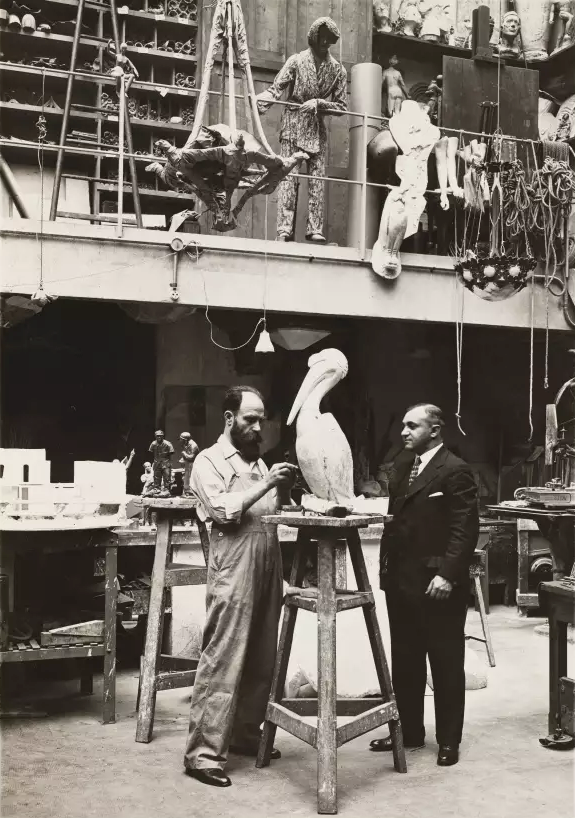
Cheuret exhibited regularly at the Salon of French Artists which was the milieu that Auguste Rodin frequented alongside Jean-Baptiste Carpeaux and Antoine Bourdelle.
Being an officer in the 1st engineering corps during WW1, he was wounded twice but later on was awarded the Legion of Honour in 1920.
This is after the war that the artist secured important commissions and he was strongly influenced by the images of Tutankhamun's tomb which was discovered on November 4, 1922.
Howard Carter made headlines and the luxurious objects and golden artifacts still nowadays remain one of the most important archaeological discoveries to date.

Cheuret is synonymous with the execution of bronze and alabaster with the representation of wild animals especially fauna and birds which can be seen for example in his sublime gilt-bronze and alabaster wall lights below designed in circa 1925.
He knew how to leverage the use of industrial and clean lines of the Art Deco period.
In 1925 he started selling his artifacts such as light fixtures, sculptures and furnishings at the Universal Exhibition in Paris where he rented a stall on the Pont Alexandre III.
The sculptor took on many high-level commissions for commemorative structures in Paris such as the Père Lachaise and Montparnasse cementaries but also the war memorial in Cannes.
Albert Cheuret's style unquestionably to this day springs to mind a repertoire of exotic flora and more often than not the depiction of birds (owls, herons, pheasants and raptors) with the use of geometric decor of the Art Deco sensibility.
He passed away in 1966.


